
Building a successful digital product starts with validating the idea before investing significant time and resources into full-scale development. That is where the Minimum Viable Product (MVP) development process becomes essential. An MVP helps startups and businesses launch a product with only the most important features needed to solve a specific problem for early users. This approach reduces development risks, saves costs, and allows teams to collect valuable market feedback before scaling.
Whether you are a startup founder, product manager, or enterprise team, following a clear MVP development process helps transform an idea into a launch-ready product efficiently. In this blog, we will walk through 8 essential steps to take your MVP from concept to launch successfully.
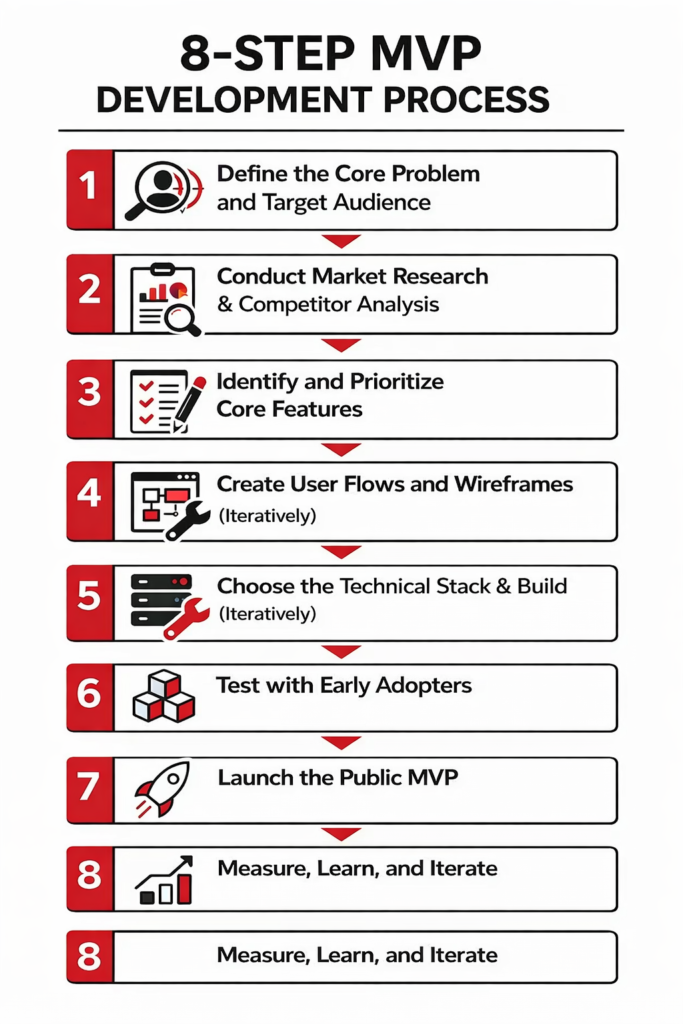
1. Define Your Core Problem and Target Audience
The first step in the MVP development process is identifying the main problem your product is built to solve.
A successful MVP starts with a clear understanding of the user’s pain points. Before moving into development, take time to define what challenge your audience is facing and why solving it matters.
Understanding your target audience helps shape the product’s features, design, and overall direction. Whether you are building an MVP for a startup or an enterprise solution, your focus should remain on solving a real and meaningful problem.
Consider factors such as:
- user pain points
- industry or niche
- target market size
- business needs
- user behavior
- existing alternatives
The clearer the problem and audience, the better your chances of building an MVP that gains market acceptance.
2. Conduct Market Research & Competitor Analysis
Once the problem and audience are clear, the next step is understanding the market.
Research helps you validate whether there is real demand for your product idea. Study your competitors to learn what solutions already exist and where the market gaps are.
Competitor analysis allows you to discover opportunities to differentiate your MVP.
Look into:
- competitor products and features
- customer reviews and complaints
- pricing structures
- market demand
- underserved audience segments
This step helps you build a product that fills an actual market gap instead of repeating what already exists.
3. Identify and Prioritize Core Features
An MVP should focus only on the features that are necessary to solve the core problem.
Avoid feature overload during the initial launch. The purpose of an MVP is to validate the idea quickly, not to launch a fully developed product.
List all possible features, then prioritize only the must-haves.
Focus on:
- core functionality
- primary user journey
- key problem-solving features
- basic onboarding
- essential integrations
This keeps development lean and helps you launch faster while maintaining product value.
4. Create User Flows and Wireframes
Before building the product, map out how users will interact with it.
User flows help define the journey from the moment a user enters the product to the completion of their main task.
Wireframes provide a visual structure of the product interface and help teams align on the layout and functionality before development begins.
This stage should include:
- homepage structure
- onboarding screens
- navigation flow
- feature screens
- call-to-action placement
A clear wireframe reduces confusion during development and improves the user experience.
5. Choose the Technical Stack & Build
After planning the product structure, the next step is selecting the right technology stack.
Choose tools, frameworks, and platforms based on scalability, budget, speed, and future product goals.
Your technical stack may include:
- front-end framework
- back-end language
- database system
- cloud hosting
- APIs and integrations
Once the stack is finalized, begin development with a strong focus on speed, usability, and performance.
The goal is to build a functional MVP that solves the main problem without unnecessary complexity.
6. Test with Early Adopters
Before launching publicly, release the MVP to a small group of early users.
These users provide valuable real-world feedback that helps identify bugs, usability issues, and missing features.
Pay close attention to:
- ease of use
- performance issues
- user feedback
- feature relevance
- onboarding friction
Early testing helps validate assumptions and reduces the risk of a failed public launch.
7. Launch the Public MVP
Once testing and refinements are complete, launch your MVP to the market.
This launch should focus on reaching your target audience through the right channels, such as:
- landing pages
- social media campaigns
- startup communities
- email marketing
- product launch platforms
The goal at this stage is to attract users, validate demand, and begin collecting product usage data.
Remember, this is still a learning phase.
8. Measure, Learn, and Iterate
The final step is continuous improvement.
After launch, track how users interact with the product and measure performance against your goals.
Monitor important metrics such as:
- signups
- retention rate
- churn
- conversion rate
- customer feedback
- feature usage
Use these insights to improve the product, add new features, and refine the user experience.
This iterative process transforms your MVP into a scalable, market-ready product.
Conclusion
Building and launching a successful MVP is a strategic process that requires careful planning, smart execution, and continuous improvement. From identifying the core problem to collecting user feedback after launch, every step plays an important role in validating your idea and reducing risk.
Whether you are a startup testing a new concept or an enterprise launching a new digital solution, following a structured MVP development process helps you move faster, save costs, and build a product that truly delivers value.
At TorontoDigits, we help startups and enterprises turn ideas into high-quality MVPs that are built for speed, scalability, and real market validation.
Ready to bring your product idea to life? Get in touch with us today, and let’s build your MVP together.
FAQs
1. What is an MVP?
An MVP, or Minimum Viable Product, is the first basic version of a product that includes only the essential features needed to solve a core problem. It is designed to help businesses launch quickly, attract early users, and gather valuable feedback for future improvements.
2. Why is an MVP important for startups?
An MVP is important because it allows startups to test their business idea in the real market without investing heavily in full-scale development. It helps reduce costs, validate demand, and collect user insights that guide future product decisions.
3. How long does it take to build an MVP?
The time required to build an MVP depends on the product’s complexity and feature scope. In most cases, it can take anywhere from a few weeks to a few months. Simpler software MVPs can be launched faster, while more advanced solutions may require additional time.
4. What features should be included in an MVP?
Your MVP should include only the core features that directly solve your users’ main problem. The focus should be on functionality and value rather than adding extra features that may delay the launch.
5. How do I test my MVP with users?
You can test your MVP by sharing it with early adopters, beta users, or a select target audience. Gather feedback through surveys, interviews, usability tests, and product analytics to understand how users interact with the product and what improvements are needed.
From idea to working AI MVP
Most ideas never become real products because the process is slow, expensive, and unclear.
We simplify that.
Using AI and a structured approach, we help you turn your idea into a working MVP – fast. Instead of overbuilding, we focus on validating what matters, building only what’s needed, and getting real feedback early.
You move faster, reduce risk, and gain clarity on what to build next